

Defining and Predicting Housing Strength for Mounted Bearings Design Considerations, Research and Testing Methods
 Cast iron is commonly used for mounted bearing units, desirable for its relative structural rigidity, strength under compression and corrosion resistance. However, some applications require very high impact loads or non-horizontal mounting, where cast iron does not provide adequate strength. Cast steel offers a strong alternative.
It has approximately twice the yield strength as comparable cast iron and offers greater breakage resistance in tougher applications. Ductile iron also far exceeds cast iron in strength and can be advantageous for certain housing geometries.
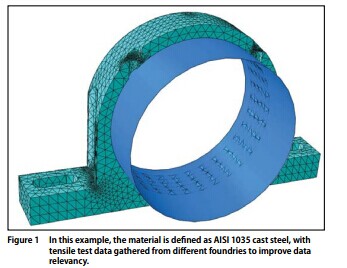
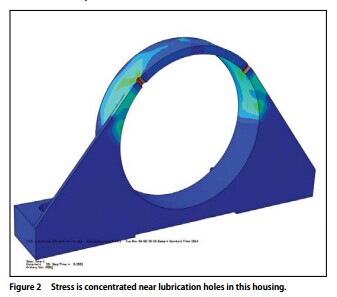
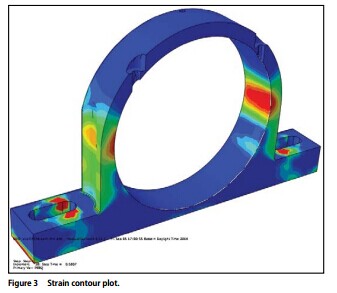
Through FEA modeling, Timken is able to calculate and define accurate fracture strain and stress values. Breaking strength for cast steel housings is estimated with a non-linear elastic-plastic analysis with an isotropic hardening model. Based on the housing’s material properties, ductile damage data is entered into the FEA models to check the maximum strain of each element. As the housing load is increased, the material hardens while elements elongate and exceed critical strain thresholds. The load on the housing reaches a maximum, followed by ductile fracture.
Typical strain patterns are illustrated in Figures 2 and 3. Simulated modeling that follows an established method, as outlined above, allows Timken to predict housing strengths, enabling the customer to create a more reliable and dependable design.
Cast iron is commonly used for mounted bearing units, desirable for its relative structural rigidity, strength under compression and corrosion resistance. However, some applications require very high impact loads or non-horizontal mounting, where cast iron does not provide adequate strength. Cast steel offers a strong alternative.
It has approximately twice the yield strength as comparable cast iron and offers greater breakage resistance in tougher applications. Ductile iron also far exceeds cast iron in strength and can be advantageous for certain housing geometries.
Through FEA modeling, Timken is able to calculate and define accurate fracture strain and stress values. Breaking strength for cast steel housings is estimated with a non-linear elastic-plastic analysis with an isotropic hardening model. Based on the housing’s material properties, ductile damage data is entered into the FEA models to check the maximum strain of each element. As the housing load is increased, the material hardens while elements elongate and exceed critical strain thresholds. The load on the housing reaches a maximum, followed by ductile fracture.
Typical strain patterns are illustrated in Figures 2 and 3. Simulated modeling that follows an established method, as outlined above, allows Timken to predict housing strengths, enabling the customer to create a more reliable and dependable design.
 Modeling is only part of the process. Testing is also used to verify the modeling assumptions and provide better and more realistic model parameters.
Physical Testing FEA simulation assumptions were based on findings for housings loaded to the point of fracture. To determine these figures, Timken housings of different sizes were selected and loaded in a hydraulic press outfitted with specialized universal tooling then tested at a range of loads.
The universal tooling used for these experiments is able to break housings in 180-, 150- and 90-degree loading directions based on differing setup configurations, reflective of the unconventional angles in which pillow blocks are installed in the real world. Since the estimated load necessary for housing fracture in these simulations could exceed the bearing static limit, no bearings were used in this exercise. Instead, they were replaced with round bars. Various styles of solid block housings and split block housings were physically tested.
Each test was performed using properly controlled loading cycles. Hydraulic fluid was slowly metered into the load piston using a control valve. A computer recorded the values of the load cell throughout the test so the maximum loads could be determined.
Multiple replicates were tested in each of the loading directions. The results of the test indicated variability between the replicates in load magnitude as well as breaking location. For example, a four bolt housing had three different failure locations when loaded in the 180-degree direction. The attachment bolts through the base flange had to be supported in each test to prevent bolt breaking and force a housing break. This was necessary even when using Grade 9 quality bolts.
Modeling is only part of the process. Testing is also used to verify the modeling assumptions and provide better and more realistic model parameters.
Physical Testing FEA simulation assumptions were based on findings for housings loaded to the point of fracture. To determine these figures, Timken housings of different sizes were selected and loaded in a hydraulic press outfitted with specialized universal tooling then tested at a range of loads.
The universal tooling used for these experiments is able to break housings in 180-, 150- and 90-degree loading directions based on differing setup configurations, reflective of the unconventional angles in which pillow blocks are installed in the real world. Since the estimated load necessary for housing fracture in these simulations could exceed the bearing static limit, no bearings were used in this exercise. Instead, they were replaced with round bars. Various styles of solid block housings and split block housings were physically tested.
Each test was performed using properly controlled loading cycles. Hydraulic fluid was slowly metered into the load piston using a control valve. A computer recorded the values of the load cell throughout the test so the maximum loads could be determined.
Multiple replicates were tested in each of the loading directions. The results of the test indicated variability between the replicates in load magnitude as well as breaking location. For example, a four bolt housing had three different failure locations when loaded in the 180-degree direction. The attachment bolts through the base flange had to be supported in each test to prevent bolt breaking and force a housing break. This was necessary even when using Grade 9 quality bolts.
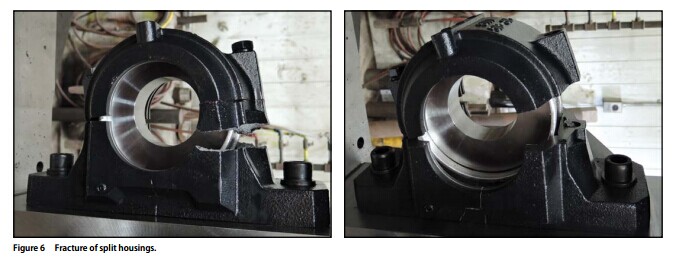 The housing break failures, as seen in Figure 6, were ductile in nature, as demonstrated by the visible deformation in the housing before fracture occurred. These results were consistent with the expectations for cast steel material and assumptions based upon FEA findings. Large plastic deformation was seen at the bolt attachment area on the flanges, though no ultimate fractures occurred there. Breaking load, displacement and break location data were collected from each test.
The methodology for analyzing and testing split housings was similar to that of solid housings. The testing showed that the gray cast iron housings had a more brittle failure mode with little deformation before fracture. Breaking loads were lower than the cast steel due to the material strength difference. The ductile iron housings had larger strains than the gray iron at fracture, but not as great as the cast steel parts. (See Fig. 6.)
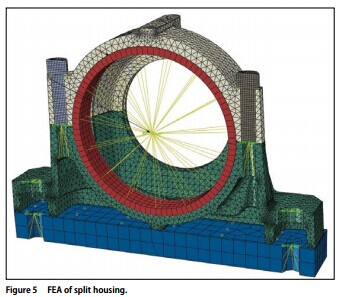
In the FEA, the gray cast iron housing failure criteria were defined using an extended fracture mechanics model. In comparison, the ductile iron housings used the same failure model as the solid block housings, but with a smaller fracture strain definition. The split housings also introduced another failure mode, which was bolt fracture on some of the housings. To account for this, FEA models were enhanced to include bolt ductile damage failure criteria. (See Fig. 5.)
Housing Strength Test Results
The Timken methodology for determining housing breaking strength can help equipment designers and end users make informed decisions on the advantages and benefits of each of Timken’s housed units. Through this rigorous testing process, Timken established not just the strength of its materials, but also the unique applications in which its portfolio of mounted bearings and housings will best perform, backing housing strength estimates with conclusive data.
Failure modes may vary based on casting geometry, casting material, and cap bolt size and grade. Split housings enable a simpler assembly and can help reduce overall installation cost, but do not maintain the same overall strength of comparable single-piece, solid block housings. Solid cast steel housing strength values generally exceed the bearing capacity regardless of load direction. Using a conservative approach, published housing strength values for solid block housed units were established using minimum material properties.
Gray cast iron generally has a smaller load-carrying capacity at varying orientations than ductile cast iron. While gray cast iron can be a more cost-effective material than ductile iron, it may not be the appropriate choice for more demanding applications in non-horizontal load bearing applications.
Easy-to-use safe load guidelines for Timken split housings, where load is not applied directly into the base or if the base is unsupported (P0) have been developed. The safe load is the maximum suggested load to be applied to the housing depending on the direction of the load. The safe load guidelines for split housings account for the breaking strength of the housing and the breaking strength of the cap bolts.
A commonly accepted safety factor of five is used for the breaking strength of the split housing material, and a safety factor of three is used for the cap bolt breaking strength. Additional safety factors may be applied by the user for safety-critical applications.The published safe load values assume the housing has been properly secured to the base structure and proper torque has been applied to the cap bolts.
The housing break failures, as seen in Figure 6, were ductile in nature, as demonstrated by the visible deformation in the housing before fracture occurred. These results were consistent with the expectations for cast steel material and assumptions based upon FEA findings. Large plastic deformation was seen at the bolt attachment area on the flanges, though no ultimate fractures occurred there. Breaking load, displacement and break location data were collected from each test.
The methodology for analyzing and testing split housings was similar to that of solid housings. The testing showed that the gray cast iron housings had a more brittle failure mode with little deformation before fracture. Breaking loads were lower than the cast steel due to the material strength difference. The ductile iron housings had larger strains than the gray iron at fracture, but not as great as the cast steel parts. (See Fig. 6.)
In the FEA, the gray cast iron housing failure criteria were defined using an extended fracture mechanics model. In comparison, the ductile iron housings used the same failure model as the solid block housings, but with a smaller fracture strain definition. The split housings also introduced another failure mode, which was bolt fracture on some of the housings. To account for this, FEA models were enhanced to include bolt ductile damage failure criteria. (See Fig. 5.)
Housing Strength Test Results
The Timken methodology for determining housing breaking strength can help equipment designers and end users make informed decisions on the advantages and benefits of each of Timken’s housed units. Through this rigorous testing process, Timken established not just the strength of its materials, but also the unique applications in which its portfolio of mounted bearings and housings will best perform, backing housing strength estimates with conclusive data.
Failure modes may vary based on casting geometry, casting material, and cap bolt size and grade. Split housings enable a simpler assembly and can help reduce overall installation cost, but do not maintain the same overall strength of comparable single-piece, solid block housings. Solid cast steel housing strength values generally exceed the bearing capacity regardless of load direction. Using a conservative approach, published housing strength values for solid block housed units were established using minimum material properties.
Gray cast iron generally has a smaller load-carrying capacity at varying orientations than ductile cast iron. While gray cast iron can be a more cost-effective material than ductile iron, it may not be the appropriate choice for more demanding applications in non-horizontal load bearing applications.
Easy-to-use safe load guidelines for Timken split housings, where load is not applied directly into the base or if the base is unsupported (P0) have been developed. The safe load is the maximum suggested load to be applied to the housing depending on the direction of the load. The safe load guidelines for split housings account for the breaking strength of the housing and the breaking strength of the cap bolts.
A commonly accepted safety factor of five is used for the breaking strength of the split housing material, and a safety factor of three is used for the cap bolt breaking strength. Additional safety factors may be applied by the user for safety-critical applications.The published safe load values assume the housing has been properly secured to the base structure and proper torque has been applied to the cap bolts.
 Figure 7 shows a comparison of housing safe loads for both cast iron and ductile iron relative to shaft size and angle of the applied load. This shows the importance of housing design and material selection in selecting the proper housing for a given application.
By using FEA results calibrated with experimental testing, Timken has created a methodology to predict housing strength without testing each unit.
Through this combination of advanced modeling and realworld experience, Timken is able to provide estimated housing strength of its mounted bearing offerings. Actionable, accessible data is one more way Timken meets the increasing demands of heavy industry every day.
Figure 7 shows a comparison of housing safe loads for both cast iron and ductile iron relative to shaft size and angle of the applied load. This shows the importance of housing design and material selection in selecting the proper housing for a given application.
By using FEA results calibrated with experimental testing, Timken has created a methodology to predict housing strength without testing each unit.
Through this combination of advanced modeling and realworld experience, Timken is able to provide estimated housing strength of its mounted bearing offerings. Actionable, accessible data is one more way Timken meets the increasing demands of heavy industry every day.
1.The news above mentioned with detailed source are from internet.We are trying our best to assure they are accurate ,timely and safe so as to let bearing users and sellers read more related info.However, it doesn't mean we agree with any point of view referred in above contents and we are not responsible for the authenticity. If you want to publish the news,please note the source and you will be legally responsible for the news published.
2.All news edited and translated by us are specially noted the source"CBCC".
3.For investors,please be cautious for all news.We don't bear any damage brought by late and inaccurate news.
4.If the news we published involves copyright of yours,just let us know.



BRIEF INTRODUCTION
Cnbearing is the No.1 bearing inquiry system and information service in China, dedicated to helping all bearing users and sellers throughout the world.
Cnbearing is supported by China National Bearing Industry Association, whose operation online is charged by China Bearing Unisun Tech. Co., Ltd.
China Bearing Unisun Tech. Co., Ltd owns all the rights. Since 2000, over 3,000 companies have been registered and enjoyed the company' s complete skillful service, which ranking many aspects in bearing industry at home and abroad with the most authority practical devices in China.