

Control System Techniques—Dampers
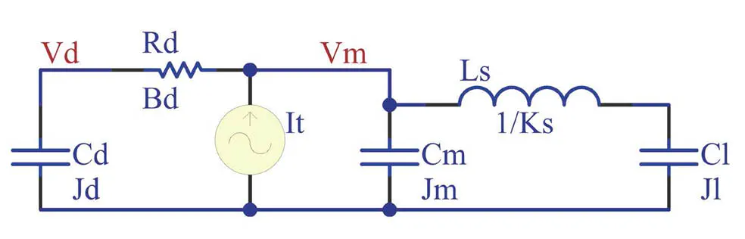
Figure 1b—Electrical model of damper with motor inertia, torsion spring and load inertia.
Closed-loop control systems can handle a wide range of motions with a wide range of loads if the control system and the mechanics of the system are properly designed for the task. A couple of the more difficult combinations to design for are high inertial mismatches and backlash with hard gearing. The question is not just how to make the system stable but also how to get the desired performance.
Physical Viscous Inertial Damper
In “Control System Techniques—Dampers (Part 1)” [PTE, Vol. 18, No. 7; October 2024] we showed how adding a mechanical damper to a motor/load mass section reduces the resonance peaking in the system. In addition to reducing the peaking, a damper raises the system’s phase margin. The combination of reduced resonance peaking with more phase margin allows the gain of the system to be increased significantly. We will get back to this, but more gain allows for wider bandwidth and tighter control of the load. More gain/bandwidth is also one of the fundamental ways to deal with stiction.
We will continue with the motor/damper/high inertia system. A physical viscous inertial damper (Figure 1) is shown mounted to the motor inertia (stiff compared to the viscous coupling of the grease), with the 100:1 inertia attached to the motor via a shaft. The impedance of the damper is to the left of the current (torque source), while the motor inertia, shaft torsion, and load inertia are shown to the right of the torque source in both the schematic and physical representations.
Whenever the motor velocity is greater than the damper inertia velocity, shear occurs in the viscous oil coupling them inside the damper, and the net torque available to accelerate the motor and load is reduced. Similarly, whenever the damper inertia velocity exceeds the motor velocity, the damper supplies torque into the system. Rapid changes in velocity, such as due to resonance, cause more shear and greater dissipation of vibrational energy into the viscous grease, removing the vibrational excitations from the system.
The improved gain and phase margins of the system allow for higher gains, reduced error and higher speed operation (wider bandwidth). The undesired part is that the damper is typically on the order of half or more of the size of the motor, and often a couple of times more expensive!
1.The news above mentioned with detailed source are from internet.We are trying our best to assure they are accurate ,timely and safe so as to let bearing users and sellers read more related info.However, it doesn't mean we agree with any point of view referred in above contents and we are not responsible for the authenticity. If you want to publish the news,please note the source and you will be legally responsible for the news published.
2.All news edited and translated by us are specially noted the source"CBCC".
3.For investors,please be cautious for all news.We don't bear any damage brought by late and inaccurate news.
4.If the news we published involves copyright of yours,just let us know.
BRIEF INTRODUCTION
Cnbearing is the No.1 bearing inquiry system and information service in China, dedicated to helping all bearing users and sellers throughout the world.
Cnbearing is supported by China National Bearing Industry Association, whose operation online is charged by China Bearing Unisun Tech. Co., Ltd.
China Bearing Unisun Tech. Co., Ltd owns all the rights. Since 2000, over 3,000 companies have been registered and enjoyed the company' s complete skillful service, which ranking many aspects in bearing industry at home and abroad with the most authority practical devices in China.
