

A3 examines adoption advancements and education
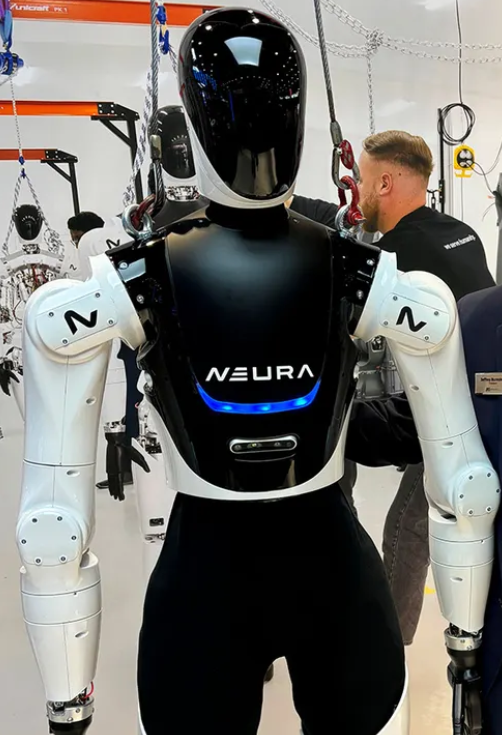
Jeff Burnstein stands with a humanoid robot from NEURA. (All Photos: A3)
As someone who has spent more than four decades involved in the robotics industry, I can say unequivocally that this is the most exciting time ever. From a technology that was originally used predominantly by U.S. automotive companies, robotics has now spread to nearly every industry and every country around the world.
Advances in artificial intelligence and robotics have created enormous interest from the press, public and policy makers. We’re now constantly hearing about “physical AI,” which essentially means giving robots the intelligence to perform far more tasks than ever before, even without being programmed. The real fascination now is around humanoid robots, in part because of the battle for global leadership in this emerging space.
This year A3 is focused on several key projects related to advancing the adoption of robotics and to educating people about what’s real and what’s hype in this brave new world of robotics. Here are three main areas of emphasis for 2026:
1. Advocating for a U.S. National Robotics Strategy
Robotics was invented in the United States. The first industrial robot was installed in a General Motors plant in 1961. Robots were going to be the next “industrial revolution.” But even as the industry grew in the United States, adoption was accelerating faster in Japan, where robotics was more fully embraced by industry and the Japanese government. Japanese robot makers like Kawsaki, Fanuc, and Yaskawa became major players. Our trade association urged U.S. government leaders to provide more incentives for adopting robots or risk losing leadership to Japan. Ultimately, our advocacy efforts fell on deaf ears, and Japan indeed became the world leader, in large part due to government support.
Fast forward 25 years or so and it was China that realized it needed to become a leader in adopting robotics. National strategies were put in place to become not only the world’s leaders in the use of robots but ultimately to become the world’s leading manufacturer of robots. And while that second goal may not have been achieved yet, the first goal was. China now dwarfs the rest of the world in robot use and the number of robots manufactured locally is rising fast. In the new field of humanoid robots, China is moving quickly to establish leadership.
A3 is once again advocating for a national robotics strategy in the United States, but this time policy makers are listening. Recently more than one piece of legislation has been introduced, including the National Commission on Robotics Act (H.R. 7334) which we believe, if passed, would be the first step towards on the path to a full U.S. robotics strategy. Here is a link to the full text of our strategy recommendations: https://www.automate.org/a3/advocacy-principles
The U.S. government is also considering Executive Orders on robotics and is conducting a 232 National Security Investigation into Foreign Robots and Components which could lead to additional tariffs on products made outside of the United States. We believe that in the near-term, if the United States is going to successfully reshore manufacturing at scale, we’ll need a tremendous amount of automation, much of which is manufactured in allied nations like Japan, Germany and South Korea. Many of the components aren’t readily available in the United States and we will need time to build a stronger supply chain. Increased adoption of robotics would potentially lead more companies to manufacture here, another reason why the United States should consider incentivizing companies to adopt robotics. Therefore, we have not advocated for additional tariffs on traditional industrial robots and key components such as motors, gears, and bearings.
1.The news above mentioned with detailed source are from internet.We are trying our best to assure they are accurate ,timely and safe so as to let bearing users and sellers read more related info.However, it doesn't mean we agree with any point of view referred in above contents and we are not responsible for the authenticity. If you want to publish the news,please note the source and you will be legally responsible for the news published.
2.All news edited and translated by us are specially noted the source"CBCC".
3.For investors,please be cautious for all news.We don't bear any damage brought by late and inaccurate news.
4.If the news we published involves copyright of yours,just let us know.
BRIEF INTRODUCTION
Cnbearing is the No.1 bearing inquiry system and information service in China, dedicated to helping all bearing users and sellers throughout the world.
Cnbearing is supported by China National Bearing Industry Association, whose operation online is charged by China Bearing Unisun Tech. Co., Ltd.
China Bearing Unisun Tech. Co., Ltd owns all the rights. Since 2000, over 3,000 companies have been registered and enjoyed the company' s complete skillful service, which ranking many aspects in bearing industry at home and abroad with the most authority practical devices in China.
