

NTN Developed World Lightest “Intelligent In-wheel” for the Next-generation EV
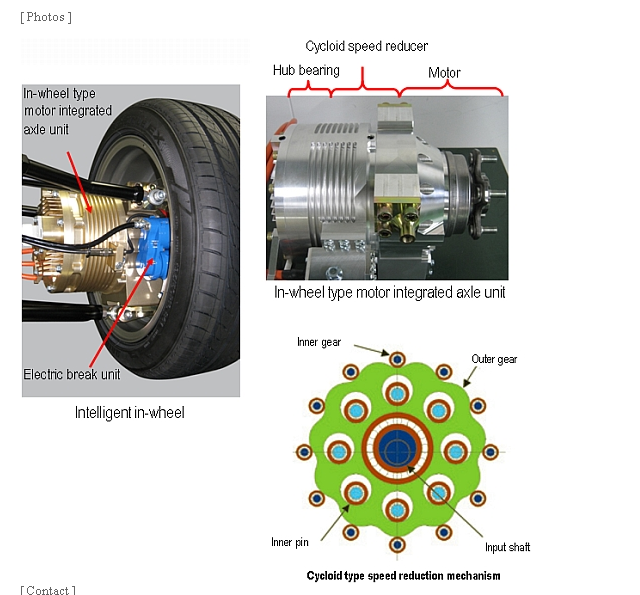 In recent years, the development of next generation vehicles like the EV has become an area of focus for issues related to both the environment and energy. With these issues in mind, NTN has been striving to develop an “In-wheel motor” by integrating a motor in a respective wheel. When comparing the in-wheel design to the traditional installation of a motor on the vehicle body, some advantages are that it requires a smaller amount of space for installation by using only the corner of the vehicle, and it improves in-vehicle stability through the individual control of driving force of each wheel. Some disadvantages of the in-wheel design include a reduction in operating stability due to the increase of weight underneath the suspension spring, the ride quality, and a reduction in battery life. All are major issues and weight reduction was necessary.
In order to solve those issues, NTN decided to combine a small, high speed, high output, high efficiency motor with a high reduction ratio, high speed, high load capacity speed reducer. To attain high speed, high output, and high efficiency of a small motor, design and control logic of the motor (such as loss of rotor/stator and distribution of mass) were optimized. In addition, heat generation was reduced by optimizing internal specifications and improving the efficiency; making a water-cooling system unnecessary while also providing a reduction in mass. The “Cycloid speed reduction mechanism” used in this application has the high speed characteristics of a small motor, and is capable of amplifying motor torque transmitted to the tire. Using NTN's high precision and long life rolling bearing technologies, NTN succeeded in enhancing the limits of speed and loading capacity of the cycloid speed reduction mechanism to a level suitable for the electric vehicle.
NTN is planning to introduce this new product to the market in 2012. It was exhibited at the “2010 Automotive Engineering Exposition” held in the Pacifico Yokohama during May 19th through the 21st.
[ Features of the Intelligent in-wheel ]
• Intelligent properties using electric driving, electric braking, load detection, and control technologies
· Fuel consumption (Electricity consumption) and safety during driving are improved.
· Degree of freedom in vehicle design significantly increases.
· Ensuring motion performances responding to customer needs is possible
• Light weight, high output, high speed, and long life by unitization
· World lightestv
· Small car can be driven by these two units (for two wheels)
· Max. speed of 150km/h achieved
· Durability of 300,000 km ensured
• Small, high speed, high output, and high efficiency motor installed
· Interior permanent magnet type synchronous motor (IPM motor) applied
· Air-cooling (Lubrication oil circulation cooling): Efficiency is enhanced to reduce heat generation and water-cooling system is unnecessary.
· High performance was achieved through the optimized design by CAE technology and the establishment of optimized control logics.
· Down sizing was achieved by installing magnetic type angle sensor (in-house development) for detection of rotor angle.
• World highest speed, high efficiency, high loading capacity, and high speed reduction ratio cycloid speed reduction mechanism adopted.
· Counter weight (for balancing) for reduction of vibration due to imbalance of inertia force is used to increase the permissible number of revolutions.
· Efficiency was improved applying rolling bearings to contact positions inside the cycloid speed reducer.
· Small and high loading capacity bearing using the material and heat treatment technologies fostered for bearings was applied.
· High speed reduction ratio (Speed reduction ratio: 1/11)
Small actuator for electric brakes with sufficient braking force using own planetary roller screw type linear motion mechanism (Suppress pressure generating mechanism). Refer to the press release of January 25, 2008.
Forces in three axial directions acting between road surface and wheel are detected by measuring minute strain generated on hub bearing. Refer to the press release of March 17, 2010.
Motor rotary angle detection sensor. Down sizing was achieved by integrating the high-resolution sensor technology developed by SNR into the bearing. Refer to the press release of April 28, 2010.
SNR (France based company holds the world standard technology for ABS sensor) is a NTN's consolidated subsidiary. Refer to the press release of April 18, 2008.
Control to let a motor function as a generator to convert the motion energy into electric energy and reuse the electricity in which it creates.
Comparison with those in the same output class (investigated by NTN)
In recent years, the development of next generation vehicles like the EV has become an area of focus for issues related to both the environment and energy. With these issues in mind, NTN has been striving to develop an “In-wheel motor” by integrating a motor in a respective wheel. When comparing the in-wheel design to the traditional installation of a motor on the vehicle body, some advantages are that it requires a smaller amount of space for installation by using only the corner of the vehicle, and it improves in-vehicle stability through the individual control of driving force of each wheel. Some disadvantages of the in-wheel design include a reduction in operating stability due to the increase of weight underneath the suspension spring, the ride quality, and a reduction in battery life. All are major issues and weight reduction was necessary.
In order to solve those issues, NTN decided to combine a small, high speed, high output, high efficiency motor with a high reduction ratio, high speed, high load capacity speed reducer. To attain high speed, high output, and high efficiency of a small motor, design and control logic of the motor (such as loss of rotor/stator and distribution of mass) were optimized. In addition, heat generation was reduced by optimizing internal specifications and improving the efficiency; making a water-cooling system unnecessary while also providing a reduction in mass. The “Cycloid speed reduction mechanism” used in this application has the high speed characteristics of a small motor, and is capable of amplifying motor torque transmitted to the tire. Using NTN's high precision and long life rolling bearing technologies, NTN succeeded in enhancing the limits of speed and loading capacity of the cycloid speed reduction mechanism to a level suitable for the electric vehicle.
NTN is planning to introduce this new product to the market in 2012. It was exhibited at the “2010 Automotive Engineering Exposition” held in the Pacifico Yokohama during May 19th through the 21st.
[ Features of the Intelligent in-wheel ]
• Intelligent properties using electric driving, electric braking, load detection, and control technologies
· Fuel consumption (Electricity consumption) and safety during driving are improved.
· Degree of freedom in vehicle design significantly increases.
· Ensuring motion performances responding to customer needs is possible
• Light weight, high output, high speed, and long life by unitization
· World lightestv
· Small car can be driven by these two units (for two wheels)
· Max. speed of 150km/h achieved
· Durability of 300,000 km ensured
• Small, high speed, high output, and high efficiency motor installed
· Interior permanent magnet type synchronous motor (IPM motor) applied
· Air-cooling (Lubrication oil circulation cooling): Efficiency is enhanced to reduce heat generation and water-cooling system is unnecessary.
· High performance was achieved through the optimized design by CAE technology and the establishment of optimized control logics.
· Down sizing was achieved by installing magnetic type angle sensor (in-house development) for detection of rotor angle.
• World highest speed, high efficiency, high loading capacity, and high speed reduction ratio cycloid speed reduction mechanism adopted.
· Counter weight (for balancing) for reduction of vibration due to imbalance of inertia force is used to increase the permissible number of revolutions.
· Efficiency was improved applying rolling bearings to contact positions inside the cycloid speed reducer.
· Small and high loading capacity bearing using the material and heat treatment technologies fostered for bearings was applied.
· High speed reduction ratio (Speed reduction ratio: 1/11)
Small actuator for electric brakes with sufficient braking force using own planetary roller screw type linear motion mechanism (Suppress pressure generating mechanism). Refer to the press release of January 25, 2008.
Forces in three axial directions acting between road surface and wheel are detected by measuring minute strain generated on hub bearing. Refer to the press release of March 17, 2010.
Motor rotary angle detection sensor. Down sizing was achieved by integrating the high-resolution sensor technology developed by SNR into the bearing. Refer to the press release of April 28, 2010.
SNR (France based company holds the world standard technology for ABS sensor) is a NTN's consolidated subsidiary. Refer to the press release of April 18, 2008.
Control to let a motor function as a generator to convert the motion energy into electric energy and reuse the electricity in which it creates.
Comparison with those in the same output class (investigated by NTN)
1.The news above mentioned with detailed source are from internet.We are trying our best to assure they are accurate ,timely and safe so as to let bearing users and sellers read more related info.However, it doesn't mean we agree with any point of view referred in above contents and we are not responsible for the authenticity. If you want to publish the news,please note the source and you will be legally responsible for the news published.
2.All news edited and translated by us are specially noted the source"CBCC".
3.For investors,please be cautious for all news.We don't bear any damage brought by late and inaccurate news.
4.If the news we published involves copyright of yours,just let us know.



BRIEF INTRODUCTION
Cnbearing is the No.1 bearing inquiry system and information service in China, dedicated to helping all bearing users and sellers throughout the world.
Cnbearing is supported by China National Bearing Industry Association, whose operation online is charged by China Bearing Unisun Tech. Co., Ltd.
China Bearing Unisun Tech. Co., Ltd owns all the rights. Since 2000, over 3,000 companies have been registered and enjoyed the company' s complete skillful service, which ranking many aspects in bearing industry at home and abroad with the most authority practical devices in China.