

The Science of Self-lubrication
 Common Misconceptions
Clever advertising gimmicks and inaccurate training materials are claiming “self-lubricating” or “lubed for life” capabilities for systems or components that do not fit the definition of the lubrication being an integral element of the bearing material. While these systems may be temporarily “self-lubricating”, the lubricant will eventually be used and need to be replaced. Many “lubed for life” bearings are not really lubed for life, they are simply “lubed for a long time”. Below is a description of some of these types of systems.
Types of Non Self-Lubricating Systems
Rolling Element Systems
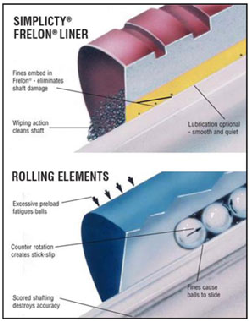
These include rotary (ball and roller) bearings, round-way linear ball bearings, and rolling element profile type monorail designs. All of these systems require some kind of external lubrication to operate. The metal-to-metal contact of the rolling element against the raceway necessitates that there be grease or oil present at all times. If this external lubricant is not present, the ball or roller will begin to make direct contact with the shaft or rail material resulting in galling and brinelling damage. Many manufacturers attempt to overcome this weakness in the design by adding oil-impregnated seals to the ends of the bearing or housing. This approach can result in some benefit to the life a rolling element bearing.
Oil impregnated bronze
Bronze bearings are very porous and have lightweight oil soaked into the material. Under the optimum conditions, this oil is drawn to the bearing surface creating a lubricated layer between the bearing and the shaft.
Graphite plugged bronze
Graphite is a good solid lubricant that is normally added to a bronze type bearing. Solid plugs of graphite are usually inserted into holes in the base bronze material.
Teflon coated materials
PTFE can be used to coat bearing surfaces in several ways. It can be applied as either a part of a powder simply dusting the bearing. It can be a sprayed mixture that adheres to the bearing surface. Or it can be part of a liquid or grease compound applied to the bearing. Any of these methods results in a very thin layer of actual lubricant that is quickly worn away and becomes ineffective.
Oil impregnated plastic
Here again, lightweight oil is added to the base material to aid in bearing lubrication. The result is decreased friction initially, but lubricant aging and dissipation quickly reduce its effectiveness.
Common Misconceptions
Clever advertising gimmicks and inaccurate training materials are claiming “self-lubricating” or “lubed for life” capabilities for systems or components that do not fit the definition of the lubrication being an integral element of the bearing material. While these systems may be temporarily “self-lubricating”, the lubricant will eventually be used and need to be replaced. Many “lubed for life” bearings are not really lubed for life, they are simply “lubed for a long time”. Below is a description of some of these types of systems.
Types of Non Self-Lubricating Systems
Rolling Element Systems
These include rotary (ball and roller) bearings, round-way linear ball bearings, and rolling element profile type monorail designs. All of these systems require some kind of external lubrication to operate. The metal-to-metal contact of the rolling element against the raceway necessitates that there be grease or oil present at all times. If this external lubricant is not present, the ball or roller will begin to make direct contact with the shaft or rail material resulting in galling and brinelling damage. Many manufacturers attempt to overcome this weakness in the design by adding oil-impregnated seals to the ends of the bearing or housing. This approach can result in some benefit to the life a rolling element bearing.
Oil impregnated bronze
Bronze bearings are very porous and have lightweight oil soaked into the material. Under the optimum conditions, this oil is drawn to the bearing surface creating a lubricated layer between the bearing and the shaft.
Graphite plugged bronze
Graphite is a good solid lubricant that is normally added to a bronze type bearing. Solid plugs of graphite are usually inserted into holes in the base bronze material.
Teflon coated materials
PTFE can be used to coat bearing surfaces in several ways. It can be applied as either a part of a powder simply dusting the bearing. It can be a sprayed mixture that adheres to the bearing surface. Or it can be part of a liquid or grease compound applied to the bearing. Any of these methods results in a very thin layer of actual lubricant that is quickly worn away and becomes ineffective.
Oil impregnated plastic
Here again, lightweight oil is added to the base material to aid in bearing lubrication. The result is decreased friction initially, but lubricant aging and dissipation quickly reduce its effectiveness.
 What makes a system self-lubricating?
1.The lubrication is an integral component of the bearing material.
2.The lubrication (typically oil or grease) is NOT added to the original bearing design.
3.The lubrication will NOT breakdown and be ineffective over time (lubricant aging).
4.The lubrication is consistently applied to the shaft surface.
5.Additional components do not add cost to the overall system.
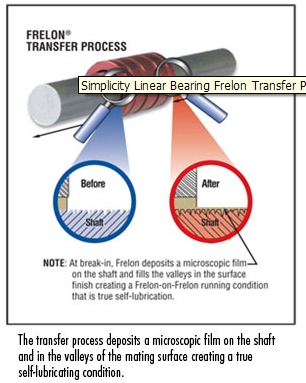
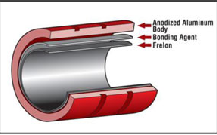
To truly be self-lubricating, a bearing system must do exactly what the name implies. It must provide its own lubrication throughout the life of the system and not have some external source facilitating lubrication for a period of time. It must be designed and manufactured into the bearing material from the beginning. One example of this is PBC Linear’s Simplicity® self-lubricating liner.
The Advantages of Simplicity’s Frelon GOLD® Liner
No metal-to-metal contact
No galling or brinelling
No catastrophic failure
No added lubricants to attract additional contaminants
Vibration dampening for smooth and quiet operation
Actual “maintenance free” operation
What makes a system self-lubricating?
1.The lubrication is an integral component of the bearing material.
2.The lubrication (typically oil or grease) is NOT added to the original bearing design.
3.The lubrication will NOT breakdown and be ineffective over time (lubricant aging).
4.The lubrication is consistently applied to the shaft surface.
5.Additional components do not add cost to the overall system.
To truly be self-lubricating, a bearing system must do exactly what the name implies. It must provide its own lubrication throughout the life of the system and not have some external source facilitating lubrication for a period of time. It must be designed and manufactured into the bearing material from the beginning. One example of this is PBC Linear’s Simplicity® self-lubricating liner.
The Advantages of Simplicity’s Frelon GOLD® Liner
No metal-to-metal contact
No galling or brinelling
No catastrophic failure
No added lubricants to attract additional contaminants
Vibration dampening for smooth and quiet operation
Actual “maintenance free” operation
 Proven Success in PBC Linear™ Products
Simplicity Linear Plain Bearings
Uni-Guide™ Modular Guides & System
Mini-Rail® Miniature Linear guide
Summary
The term “self-lubricating” should not evoke a generalized meaning that passively represents a broad range of different technologies striving for the same outcome. Self-lubricating refers to a specific performance advantage made possible by a unique product design that satisfies all aforementioned criteria: internal lubrication system, no added grease or oils (no maintenance), no lubrication breakdown and no added cost. In other words, “self-lubricating” must ensure the permanent, maintenance-free operation in even the most challenging environments. Designers need to learn to recognize the difference between the various types of lubrication options. Failure to do so will result in costly misapplications and re-designs.
Proven Success in PBC Linear™ Products
Simplicity Linear Plain Bearings
Uni-Guide™ Modular Guides & System
Mini-Rail® Miniature Linear guide
Summary
The term “self-lubricating” should not evoke a generalized meaning that passively represents a broad range of different technologies striving for the same outcome. Self-lubricating refers to a specific performance advantage made possible by a unique product design that satisfies all aforementioned criteria: internal lubrication system, no added grease or oils (no maintenance), no lubrication breakdown and no added cost. In other words, “self-lubricating” must ensure the permanent, maintenance-free operation in even the most challenging environments. Designers need to learn to recognize the difference between the various types of lubrication options. Failure to do so will result in costly misapplications and re-designs.
1.The news above mentioned with detailed source are from internet.We are trying our best to assure they are accurate ,timely and safe so as to let bearing users and sellers read more related info.However, it doesn't mean we agree with any point of view referred in above contents and we are not responsible for the authenticity. If you want to publish the news,please note the source and you will be legally responsible for the news published.
2.All news edited and translated by us are specially noted the source"CBCC".
3.For investors,please be cautious for all news.We don't bear any damage brought by late and inaccurate news.
4.If the news we published involves copyright of yours,just let us know.



Next Koyo Bearings USA Holding Job Fair
BRIEF INTRODUCTION
Cnbearing is the No.1 bearing inquiry system and information service in China, dedicated to helping all bearing users and sellers throughout the world.
Cnbearing is supported by China National Bearing Industry Association, whose operation online is charged by China Bearing Unisun Tech. Co., Ltd.
China Bearing Unisun Tech. Co., Ltd owns all the rights. Since 2000, over 3,000 companies have been registered and enjoyed the company' s complete skillful service, which ranking many aspects in bearing industry at home and abroad with the most authority practical devices in China.