

NSK Develops World's First Non-Contact Torque Sensor for Drive Shafts in Motor Vehicles
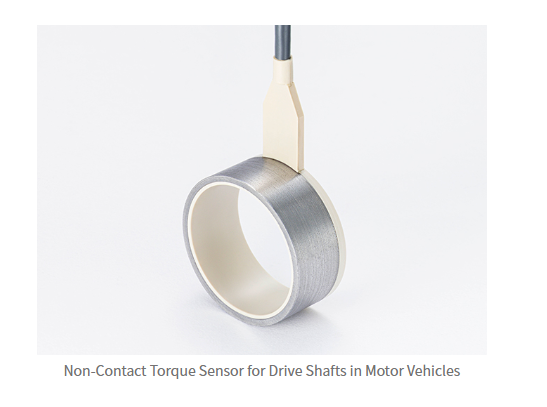
This new technology can increase fuel economy (reduce power consumption), improve ride comfort and safety, and open up a world of new possibilities across CASE.
NSK Ltd. has newly developed a non-contact torque sensor capable of measuring the torque of drive shafts in vehicles in real time. This is the first sensor in the world of this type and capability.
The sensor uses magnetic fields to detect torque by measuring minute twisting of the drive shaft that occurs naturally as it is rotated by the motor. Conventional torque sensors have been too complicated or expensive for wide scale use, but NSK's new technology makes possible a compact sensor with a simple structure that is ideal for mass production and broad adoption by automakers.
NSK's new torque sensor helps increase fuel economy (reduce power consumption), and improve ride comfort and safety. The sensor opens up a whole new world of possibilities across CASE*1. NSK is aiming for 6 billion yen in yearly sales by 2030.
Development Background
The automotive industry is currently in the midst of a once-in-a-century period of profound transformation centered around CASE*1. The car of the near future is expected to maximize safety and comfort, and reduce environmental impact. This will require vehicles to be equipped with various sensors to accurately grasp the state of the vehicle in order to execute advanced control methods.
The drive shaft is a key component that is used to transmit the power of the engine or motor to the wheels. Measuring torque at the drive shaft provides vital information that can be used to increase fuel economy, improve comfort and safety, reduce environmental impact, and even detect abnormalities or malfunction in the vehicle. However, until the introduction of NSK's new product, conventional torque sensors were too large and too complicated to be suitable for mass production vehicles.
Product features
1. Non-Contact Sensor
Achieved a non-contact design with a simple structure ideal for mass production.
High reliability due to no friction occurring between the sensor and the shaft.
2. Compact
Reduced the width of the unit by half and improved sensitivity by using a special method of wrapping the sensor coil and employing an optimized material.
3. Ease of Manufacturing
The sensor requires no grooves, coatings, or other special processing of the shaft.
Only requires shaft materials and basic surface processing methods that have a history of use in mass-production car models.
Customer Benefits
1. Better Fuel Economy (Lower Power Consumption).
The concept of pairing electric motor with two-speed transmission in EV is gaining attention as an effective method to deliver increased efficiency. NSK's torque sensor can help deliver shock-free gear shifting enabling the use of a larger step ratio to deliver 7% increased fuel economy*2.
In belt-driven CVT systems, data from NSK's torque sensor can help to adjust and reduce the hydraulic clamping force applied to the belt to the minimum required, thereby reducing transmission loss for a 1.05% increase in fuel economy*3.
2. Increased Comfort
The torque sensor can be used to achieve a super smooth and pleasant ride through advanced control that softens fluctuations in torque when changing gears and accelerating/decelerating.
3. Identify Abnormalities
By continuously monitoring and tracking torque, it is possible to predict and identify issues and abnormalities in the vehicle at an early stage before they develop into larger problems.
4. Connected
As always-online vehicles become the norm, the data gathered by the sensor can be used to identify the state of nearby vehicles, and can be shared and analyzed to identify collective road usage patterns and deliver new value to society.
As development efforts in CASE accelerate, in addition to mainline solutions for autonomous driving and automotive electrification, NSK is expanding its horizons with new connected products, such as this torque sensor, that can contribute to the further evolution of mobility on a global basis.
*2 Based on in-house simulations.
*3 Based on actual in-vehicle WLTC test results.
1.The news above mentioned with detailed source are from internet.We are trying our best to assure they are accurate ,timely and safe so as to let bearing users and sellers read more related info.However, it doesn't mean we agree with any point of view referred in above contents and we are not responsible for the authenticity. If you want to publish the news,please note the source and you will be legally responsible for the news published.
2.All news edited and translated by us are specially noted the source"CBCC".
3.For investors,please be cautious for all news.We don't bear any damage brought by late and inaccurate news.
4.If the news we published involves copyright of yours,just let us know.



Next NSK Toyama Receives Award of Excellence from Water Pollution Countermeasures Coordination Committee
BRIEF INTRODUCTION
Cnbearing is the No.1 bearing inquiry system and information service in China, dedicated to helping all bearing users and sellers throughout the world.
Cnbearing is supported by China National Bearing Industry Association, whose operation online is charged by China Bearing Unisun Tech. Co., Ltd.
China Bearing Unisun Tech. Co., Ltd owns all the rights. Since 2000, over 3,000 companies have been registered and enjoyed the company' s complete skillful service, which ranking many aspects in bearing industry at home and abroad with the most authority practical devices in China.