

Motors in Space
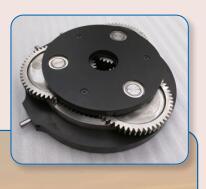
Components like motors, bearings and drives are subject to harsh environments on Earth, but they must be at the top of their game to enjoy space travel. Recent applications from Maxon Motors (Return to Mars) and the University of Michigan (Robotic Legs) illustrate the incredible requirements it takes to handle applications in space and how these components can be utilized here on Earth.
Return to Mars NASA’s Jet Propulsion Laboratory (JPL) asked Maxon to produce 10 drives for its latest Mars rover, Perseverance. For the first time, NASA is using brushless DC motors, including: nine EC 32 flat and one EC 20 flat in combination with a GP 22 UP planetary gearhead. Working closely with JPL specialists, Maxon engineers developed the drives over several years and tested them thoroughly to achieve the highest standards of quality. “We’ve learned a lot from this exciting project,” says Robin Phillips, head of the Maxon SpaceLab. “We now have very broad expertise in space applications and have established quality assurance processes that meet the expectations of the industry. Customers from other industries such as the medical sector, where requirements are often similar, can also benefit from this know-how.” Space missions place the highest demands on drive systems. This includes vibrations during the rocket launch, vacuum during the journey, impacts on landing, and the harsh conditions on the surface of Mars, where temperatures fluctuate between –125 and +20 degrees Celsius and dust penetrates everywhere. A drone helicopter called Ingenuity is attached to the bottom of the rover and includes six Maxon brushed DCX motors with a diameter of 10 millimeters controlling the tilt of the rotor blades and the direction of flight. The Perseverance rover is expected to land on Mars on February 18, 2021. Editor’s Note: Learn more on page 20.
Improving Robotic Legs In a recent article by the communications department at the University of Michigan, scientists created a robotic leg prototype that offers a more natural gait and is more energy efficient than previous designs. The key is the use of new small and powerful motors, originally designed for a robotic arm on the International Space Station. The streamlined design offers a free-swinging knee and regenerative braking, which charges the battery with energy captured when the foot hits the ground.
This feature enables the leg to more than double a typical prosthetic user’s walking needs with one charge per day. Motors in robotic legs need to fit into the space that an ordinary limb would take up. In the past, this has meant using small motors that spin quickly, and then using a series of gears to convert the fast spin into a more powerful force. The problem is that the gears are noisy, inefficient, add weight and make it harder for the joints to swing. Robert Gregg, an associate professor of electrical and computer engineering at the University of Michigan and a member of the U-M Robotics Institute, and his group surmounted this by incorporating two of those stronger space station motors, one powering the knee and the other powering the ankle. There are many benefits to using fewer gears. In addition to enabling the free-swinging knee, removing gears brought the noise level down from the scale of a vacuum cleaner to a refrigerator. Also, the regenerative braking absorbs some of the shock when the prosthetic foot hits the ground. The team’s next step is to improve the control algorithms that can help the leg automatically adjust to different terrain, changes in pace and transitions between different types of activity. Learn more here: (news.umich.edu/space-station-motorsmake-a-robotic-prosthetic-leg-more-comfortable-extendbattery-life/)
1.The news above mentioned with detailed source are from internet.We are trying our best to assure they are accurate ,timely and safe so as to let bearing users and sellers read more related info.However, it doesn't mean we agree with any point of view referred in above contents and we are not responsible for the authenticity. If you want to publish the news,please note the source and you will be legally responsible for the news published.
2.All news edited and translated by us are specially noted the source"CBCC".
3.For investors,please be cautious for all news.We don't bear any damage brought by late and inaccurate news.
4.If the news we published involves copyright of yours,just let us know.



Next GWJ Technology Introduces TBK 2014 Update
BRIEF INTRODUCTION
Cnbearing is the No.1 bearing inquiry system and information service in China, dedicated to helping all bearing users and sellers throughout the world.
Cnbearing is supported by China National Bearing Industry Association, whose operation online is charged by China Bearing Unisun Tech. Co., Ltd.
China Bearing Unisun Tech. Co., Ltd owns all the rights. Since 2000, over 3,000 companies have been registered and enjoyed the company' s complete skillful service, which ranking many aspects in bearing industry at home and abroad with the most authority practical devices in China.