

JW Winco Expands Antibacterial Products
Contact infections with viruses, fungi and bacteria were already a problem even before the pandemic – and now JW Winco is expanding its Sanline range of antibacterial products.
Bacteria with high resistance to common antibiotic therapies have been on the rise for years, especially in hospitals. These infections can become a serious problem even outside of healthcare facilities. Nursing homes, pharmacies, schools, and food production facilities as well as large-scale livestock operations are also locations at significant risk.
One part of the solution involves surfaces that people come into contact with – in other words, handles, buttons, switches, plugs, tables, keyboards and even touch screens. Bacteria, fungi and viruses can collect in these locations, form a biofilm that facilitates growth and eventually be transferred to the next user. Reliably interrupting this very simple transmission route is therefore a worthwhile objective. The fewer microorganisms present on such surfaces, the lower the infection risk.
Frequent cleaning and disinfection is one solution, but it is prone to errors and can exhibit problematic gaps. It is far more effective and reliable for the surfaces themselves to have an antimicrobial effect. Any microorganisms coming into contact with such surfaces are then automatically deactivated, and this prevents their transmission. Moreover, such effects can be very long-lasting.
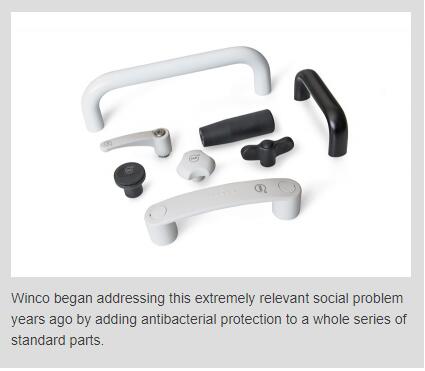
Winco began addressing this extremely relevant social problem years ago by adding antibacterial protection to a whole series of standard parts, grouped into the Sanline product family. The various handling elements – buttons, hand levers, U-handles and wing nuts – make use of two different principles. In the case of plastics, special additives with silver ions are mixed in, while metal parts are given powder coatings based on zinc molybdate.
Both principles destroy the cell walls of the microorganisms, causing them to die. For humans, contact with such activated surfaces poses no risk whatsoever. Zinc molybdate additives are of particular interest. With the help of moisture in the air, an acidic film with a pH of about 4.5 forms on the surfaces – similar to the one on human skin. The acid protons penetrate the cell membrane of the bacteria, quickly destroying them.
Both principles remain effective for a long time, even despite frequent cleanings. Note: The antibacterial properties are no replacement for cleaning or disinfection, but they serve as a long-lasting additional measure.
1.The news above mentioned with detailed source are from internet.We are trying our best to assure they are accurate ,timely and safe so as to let bearing users and sellers read more related info.However, it doesn't mean we agree with any point of view referred in above contents and we are not responsible for the authenticity. If you want to publish the news,please note the source and you will be legally responsible for the news published.
2.All news edited and translated by us are specially noted the source"CBCC".
3.For investors,please be cautious for all news.We don't bear any damage brought by late and inaccurate news.
4.If the news we published involves copyright of yours,just let us know.



Next ISO Announces Publication of New Standards
BRIEF INTRODUCTION
Cnbearing is the No.1 bearing inquiry system and information service in China, dedicated to helping all bearing users and sellers throughout the world.
Cnbearing is supported by China National Bearing Industry Association, whose operation online is charged by China Bearing Unisun Tech. Co., Ltd.
China Bearing Unisun Tech. Co., Ltd owns all the rights. Since 2000, over 3,000 companies have been registered and enjoyed the company' s complete skillful service, which ranking many aspects in bearing industry at home and abroad with the most authority practical devices in China.